By Beth Smith, M. Ed. |#smithingifted
One of the goals of The Global Innovation Lab is to help students understand that the world’s biggest challenges are not distant problems reserved for adults to solve.
They are happening right where we live.
That is especially true when we talk about water in New Mexico.
As students continue our Every Drop Counts challenge, we are moving from learning about Earth’s overall water supply to examining water through a much more personal lens:
Where does our water come from in New Mexico—and what happens when there isn’t enough to meet everyone’s needs?
That question changes the conversation.
Water is no longer just something that comes out of the faucet.
It becomes a system involving geography, agriculture, technology, economics, laws, communities, and even the United States Supreme Court.
💦 Understanding New Mexico’s Water Resources
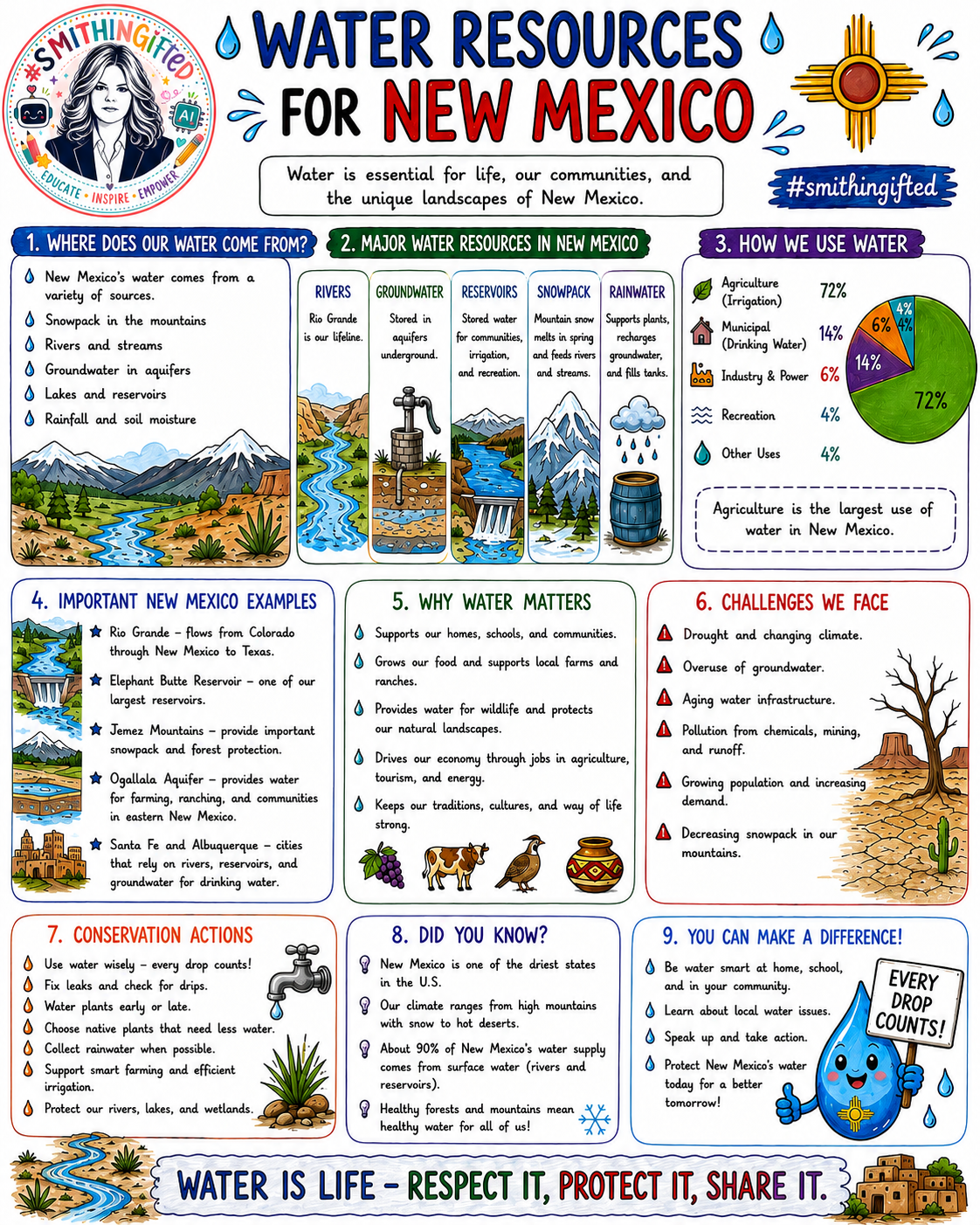
New Mexico has an incredibly diverse landscape. We have mountains covered in winter snow, rivers crossing desert landscapes, reservoirs storing water for communities and agriculture, underground aquifers, and seasonal rainfall.
Our major water resources include:
- Rivers and streams
- Groundwater stored in aquifers
- Reservoirs and lakes
- Mountain snowpack
- Rainfall and soil moisture

Students quickly discover that these resources are connected.
Snow that falls in the mountains can eventually melt and feed rivers.
Rivers supply reservoirs.
Groundwater supports homes, farms, ranches, and communities.
Rainfall can recharge soil and groundwater.
One change in the system can create a ripple effect somewhere else.
And that is exactly the kind of thinking I want students practicing.
⚖️ When Water Becomes a Supreme Court Issue
New Mexico’s water story also gives students a fascinating example of how natural resources, laws, state boundaries, and human decisions intersect.
For more than a decade, New Mexico and Texas were involved in a major U.S. Supreme Court case called Texas v. New Mexico and Colorado over water from the Rio Grande.
The dispute centered partly on groundwater pumping in southern New Mexico. Texas argued that pumping groundwater connected to the Rio Grande reduced the amount of river water ultimately available downstream.
In June 2024, the U.S. Supreme Court rejected an earlier proposed settlement between the states because the federal government also had legal interests that had to be addressed. The Court did not simply decide that New Mexico had to “give Texas more water.” Instead, it ruled that the proposed agreement could not eliminate the federal government’s claims without federal consent. (Supreme Court)
That meant the dispute continued.
Then, after additional negotiations, the U.S. Supreme Court approved a new settlement on May 26, 2026, ending more than a decade of litigation over Lower Rio Grande water. (New Mexico Secretary of State)

💧 What Does the 2026 Settlement Mean for New Mexico?
The agreement creates clearer rules for how water below Elephant Butte Reservoir is divided and managed.
Under the settlement, approximately 57% of Rio Grande Project water is allocated to New Mexico and 43% to Texas, while New Mexico also takes responsibility for reducing groundwater depletion in the Lower Rio Grande. (New Mexico Secretary of State)
New Mexico has committed to reducing groundwater depletion by about 18,200 acre-feet per year, roughly 5–7% of current Lower Rio Grande groundwater use. The state is developing programs that can include purchasing water rights from willing sellers and permanently retiring some of those rights to reduce pumping. (New Mexico Secretary of State)
For students, that number becomes much more meaningful when we ask:
Who might be affected?
The answer is: a lot of people and systems.
🌾 Farmers
Agriculture is one of the largest water users in the Lower Rio Grande.
Reducing groundwater pumping could mean some farmland is irrigated differently, planted with different crops, temporarily fallowed, or in some cases taken out of production.
New Mexico has already used voluntary programs that pay farmers to leave some land unplanted in order to conserve irrigation water. (New Mexico Legislature)
🏘️ Communities
Cities and rural communities throughout southern New Mexico depend on groundwater and Rio Grande water.
Water planners now have to think even more carefully about population growth, development, infrastructure, and long-term supply.
💼 Businesses and Industry
New industries—including large technology facilities such as data centers—become part of this discussion too.
If New Mexico is legally required to reduce groundwater depletion in one of its most important river systems, then a very reasonable question becomes:
Should new industries be allowed to rely heavily on freshwater when alternative sources or lower-water technologies might be available?
That takes our water investigation directly into economics and innovation.
🐟 Rivers and Ecosystems
Reducing excessive groundwater pumping can also help protect river flows, wetlands, habitats, and the long-term health of the aquifer.
🇲🇽 Interstate and International Water
The Rio Grande does not stop at New Mexico’s border.
Its water is shared with Texas and is also connected to the United States’ water-delivery obligations to Mexico.
That means decisions made in New Mexico can have consequences far downstream. The federal government emphasized those broader obligations during the Supreme Court litigation. (New Mexico Department of Justice)

🧠 This Is Systems Thinking in Real Life
This is where the lesson becomes incredibly powerful for gifted students.
Consider this chain:
Less snowpack
⬇️
Less water enters the Rio Grande
⬇️
Reservoir levels decline
⬇️
Farmers rely more heavily on groundwater
⬇️
Groundwater pumping affects river supplies
⬇️
Less water reaches downstream users
⬇️
States disagree over their legal shares
⬇️
The dispute reaches the U.S. Supreme Court
⬇️
New Mexico changes how groundwater is managed
A lesson that began with a water droplet has now connected:
Science + Geography + Agriculture + Economics + Government + Law + Technology + Ethics
That is the Global Innovation Lab.
🌎 Moving Beyond “Save Water”
We have all heard the traditional water-conservation lessons:
Turn off the faucet.
Take shorter showers.
Fix leaks.
Those actions matter.
But gifted students are capable of going much further.
Instead of simply telling students to conserve water, I want them asking:
Why is water conservation especially important in New Mexico?
Who should receive water during a shortage?
Should agriculture, communities, wildlife, and industry all have equal priority?
What responsibility does New Mexico have to people living downstream?
How should groundwater pumping be managed when underground water and river water are connected?
Can economic growth continue without increasing pressure on freshwater supplies?
Those are much more complicated questions.
And there may not be one perfect answer.
🌾 Water and Agriculture
One of the most important connections students explore is the relationship between water and food.
Agriculture is a major water user in New Mexico.
That means water decisions affect much more than faucets and swimming pools.
They affect:
🌽 crops
🐄 ranching
🌶️ chile production
🍇 vineyards
🌱 local farms
🏘️ rural communities
The Supreme Court settlement makes this conversation even more authentic.
If groundwater pumping has to decrease, students can investigate questions such as:
Could farmers grow crops that require less water?
Could irrigation become more efficient?
Should farmers be compensated for conserving water?
Could technology help farms produce the same amount of food using less water?
Now students are not merely identifying a problem.
They are beginning to design solutions.
🏜️ New Mexico’s Water Challenges
Our students also need to understand that New Mexico faces significant water challenges.
Among them are:
- Drought
- Increasing temperatures
- Changes in mountain snowpack
- Groundwater depletion
- Aging water infrastructure
- Pollution and runoff
- Population growth
- Interstate water obligations
- Competing demands from agriculture, cities, businesses, and ecosystems
These problems do not exist independently.
They interact.
💻 Connecting Water to New Technology
Our New Mexico water investigation also opens the door to one of the most interesting modern challenges we are exploring:
Data centers.
Data centers power much of our digital world—from cloud storage and streaming services to artificial intelligence.
But large technology facilities can also require water for cooling.
Now place that issue beside New Mexico’s commitment to reduce Lower Rio Grande groundwater depletion.
The question becomes even more interesting:
How can New Mexico welcome technology, jobs, and economic development while also meeting legal water obligations and protecting freshwater for existing communities?
Students have to consider:
Economics.
Technology.
Agriculture.
Law.
Environment.
Equity.
Future generations.
One water problem suddenly becomes a network of interconnected decisions.
💡 The Global Innovation Lab Challenge
Eventually, students move from investigators to innovators.
A powerful challenge question for this unit could be:
How might New Mexico meet its water obligations while protecting communities, agriculture, ecosystems, and opportunities for future growth?
Possible solutions might include:
- More efficient irrigation
- Water-right purchase or conservation programs
- Leak-detection technology
- Rainwater harvesting
- Wastewater reuse
- Brackish-water treatment
- Closed-loop data-center cooling
- Drought-tolerant landscaping
- Groundwater monitoring
- Community water dashboards
- Crop changes
- Aquifer-recharge projects
- Improved water infrastructure
But I don’t want to hand students the answer.
I want them to investigate the evidence and decide:
Which solutions create the greatest benefit with the fewest unintended consequences?
🔎 Start Global. Bring It Home.
One of the central ideas behind The Global Innovation Lab is that students should learn to move between global thinking and local action.
We began by examining Earth’s water.
Then we looked at water across the United States.
Now we are studying New Mexico.
From there, students can investigate their own community.
Where does our water come from?
Who uses it?
How is groundwater changing?
What industries depend on it?
How could state water decisions eventually affect us?
That is when a lesson becomes something much bigger.
Students stop studying someone else’s problem.
They begin investigating their own world.
💧 Water Is Life
New Mexico’s water story is complicated.
There will not be one solution.
There will not be one person responsible for fixing it.
And there probably will not be one perfect answer.
The U.S. Supreme Court settlement makes one thing especially clear:
Water decisions made today can shape communities for decades.
The students sitting in our classrooms now will eventually become the farmers, scientists, engineers, business owners, attorneys, teachers, elected leaders, technologists, and citizens making those decisions.
That is why we need them thinking about these issues now.
Not because elementary students are expected to solve New Mexico’s water challenges tomorrow.
But because we are teaching them how to become the people who can.
Think Bigger. Create Together. Change the World.
💧 Every Drop Counts.
#smithingifted | The Global Innovation Lab